Blog › On the course · 15 November 2026 · 5 min read
Golf club distances: a chart for amateurs
You're 140 yards from the flag. 7-iron or 8? If you're not sure, you're not alone. Most amateur golfers come up short because they pick the club for their best shot, not their normal one.
Here's a rough chart of distances by club and, more importantly, how to find your own numbers.
- Distance chart by club
- Carry and total: not the same
- How to find your distances
- Gaps between clubs
- What changes the distance
1. Distance chart by club
These are carry distances (not counting roll) for average amateur players. Use them as a starting point, not a rule: two golfers with the same handicap can be 20 yards apart with the same club.
| Club | Male amateurs | Female amateurs |
|---|---|---|
| Driver* | 210 – 230 yd | 150 – 175 yd |
| 3-wood | 185 – 210 yd | 130 – 155 yd |
| 5-wood | 175 – 190 yd | 120 – 140 yd |
| Hybrid | 165 – 185 yd | 115 – 135 yd |
| 5-iron | 155 – 170 yd | 110 – 125 yd |
| 6-iron | 140 – 160 yd | 105 – 115 yd |
| 7-iron | 130 – 150 yd | 95 – 110 yd |
| 8-iron | 120 – 135 yd | 85 – 100 yd |
| 9-iron | 110 – 125 yd | 75 – 90 yd |
| Pitching wedge | 100 – 115 yd | 65 – 80 yd |
| Gap wedge | 80 – 100 yd | 55 – 70 yd |
| Sand wedge | 65 – 80 yd | 45 – 60 yd |
| Lob wedge | 50 – 65 yd | 35 – 50 yd |
* Driver including roll. Rough figures, at sea level, no wind and with good contact. 1 yard ≈ 0.91 metres.
2. Carry and total: not the same
There are two numbers for any club:
- Carry: how far the ball travels in the air before it lands.
- Total: carry plus roll.
When you attack the green, carry is what matters. If there's a bunker in front, the ball needs to clear it in the air. With the driver, on the other hand, roll counts a lot.
3. How to find your distances
The chart is a start, but what really helps is knowing your own. Here's how:
- Measure on the course, not on the range. Range balls are usually harder and worn, and fly shorter. Trust them and you'll take too much club.
- Write down your normal shot, not your best. That 7-iron that once went 160 doesn't count. Keep what you do most of the time.
- Log several shots per club. With 5 or 6 good shots per club you have a reliable average.
- Review your numbers every few months. They change with technique, fitness and the time of year.
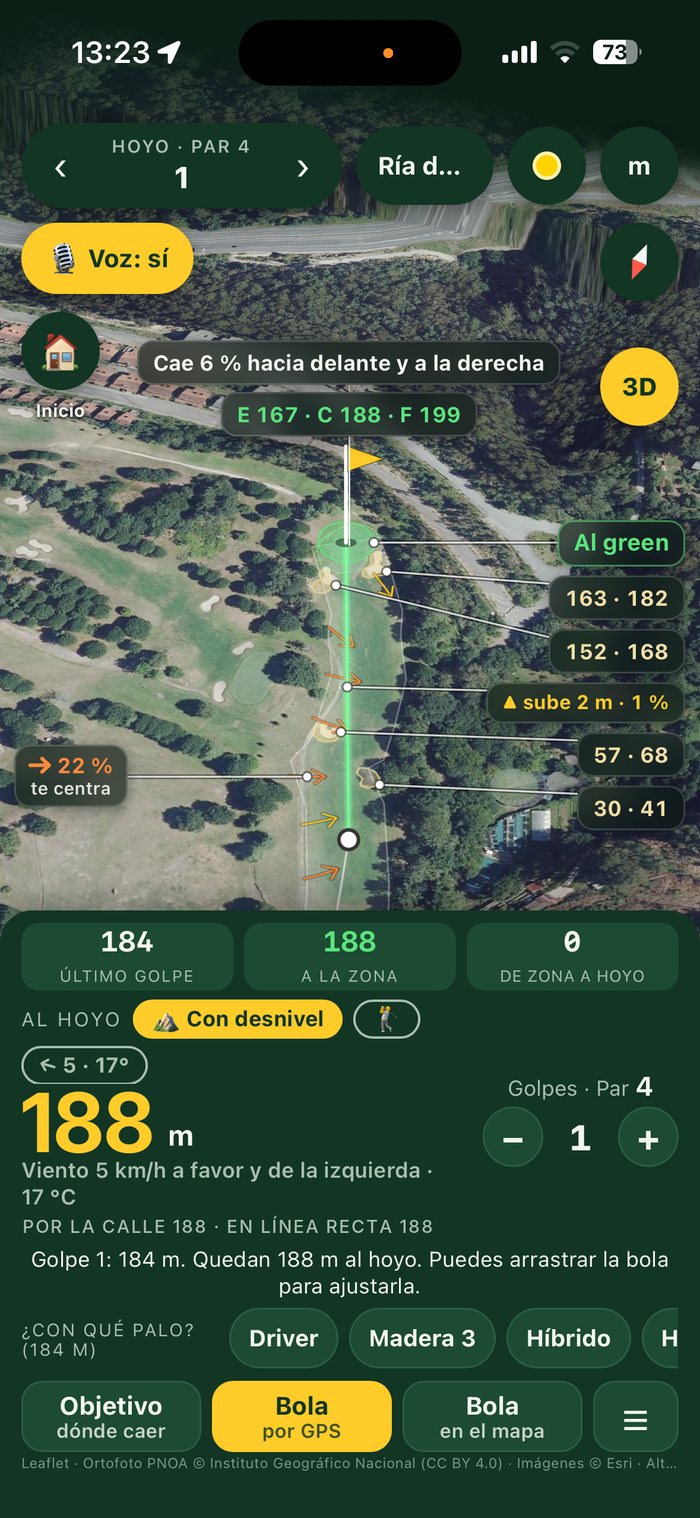
CaddieStroke puts it on your iPhone. On the course you see the GPS distance to the green and how far the shot really plays, adding slope, wind and temperature. The app suggests which club to take.
You can also ask by voice with the phone in your pocket. Courses in the UK, Ireland, the US, Australia and New Zealand are already loaded.
Try CaddieStroke free
7-day free trial. iPhone only.
4. Gaps between clubs
Between two consecutive irons there are usually about 10 to 12 yards. Once you have your numbers, go down the list:
- If two clubs go almost the same distance (less than 5 yards apart), one is spare. It often happens with the 4-iron and the hybrid.
- If there's a big gap (more than 15 yards), you're missing a club. The classic one is between the pitching wedge and the sand wedge: that's where a gap wedge fits.
Remember you can only carry 14 clubs, so it pays for each one to have its own distance.
5. What changes the distance
| Situation | Effect on distance |
|---|---|
| Uphill shot | The ball comes up short: take more club |
| Downhill shot | The ball goes further: take less club |
| Into the wind | Comes up short, more so the higher it flies |
| Downwind | Goes further, but stops less on the green |
| Cold weather | The ball flies a little shorter than in summer |
| Altitude | The ball flies further on high courses |
| Wet course | Less roll, especially with the driver |
That's why CaddieStroke shows, as well as the real distance, how far the shot plays. Note: in competition the rules don't allow slope or plays-like distance. The app has a competition mode that hides them.
In short
Use the chart to get an idea, but measure your own distances on the course, log your normal shot not your best, and check the gaps in your bag. And if you want the distance to the green and a club suggestion in your pocket, try CaddieStroke free for 7 days.
You might also like: uphill and downhill shots · how to film your swing with your phone · golf courses with GPS · golf handicap calculator.