Blog › On the course · 15 November 2026 · 5 min read
Uphill and downhill golf shots: which club to take
The rangefinder says 140 yards. You take your 140 club, hit a good shot… and it comes up short. What happened? The green was 10 yards higher, so the shot played a lot longer than the rangefinder said.
Know how far an uphill or downhill shot really plays.
CaddieStroke · 7 days free · iPhone only
Try it freeElevation is one of the most common reasons for missing greens on hilly courses. This guide explains what happens to the ball, how to judge it better by eye and how to set up when the ball is on a slope.
- What happens to the ball
- One club more, or two?
- How to judge the elevation
- When the ball is on a slope
- Can you use it in competition?
1. What happens to the ball
- Uphill: the ball lands sooner than you expect and comes up short. You need more club.
- Downhill: the ball stays in the air longer and goes further. You need less club.
The higher you hit the ball (wedges, short irons), the more elevation affects it. With low, running shots, a little less.
2. One club more, or two?
It depends on how much elevation there is, which club you use and how high you hit it. That's why no single number works for everyone, and why so many shots come up short or fly the green.
The key is not to trust the real distance alone: a shot with elevation almost never plays what the rangefinder says. If you don't know how far each of your clubs goes, start with our golf club distances chart.
3. How to judge the elevation
This is the real problem: by eye, elevation is very deceptive. A green that looks "a bit higher" could be 4 yards up or 12. Some clues:
- Look at the flag: if you can only see the top of the pole, the green is quite a lot higher.
- Use references on the course: the height of a person (nearly 2 yards) or one storey of a house (about 3 yards) helps you estimate.
- Write down what you learn: on your home course the hilly holes are always the same. Note how much more or less club you need on each.
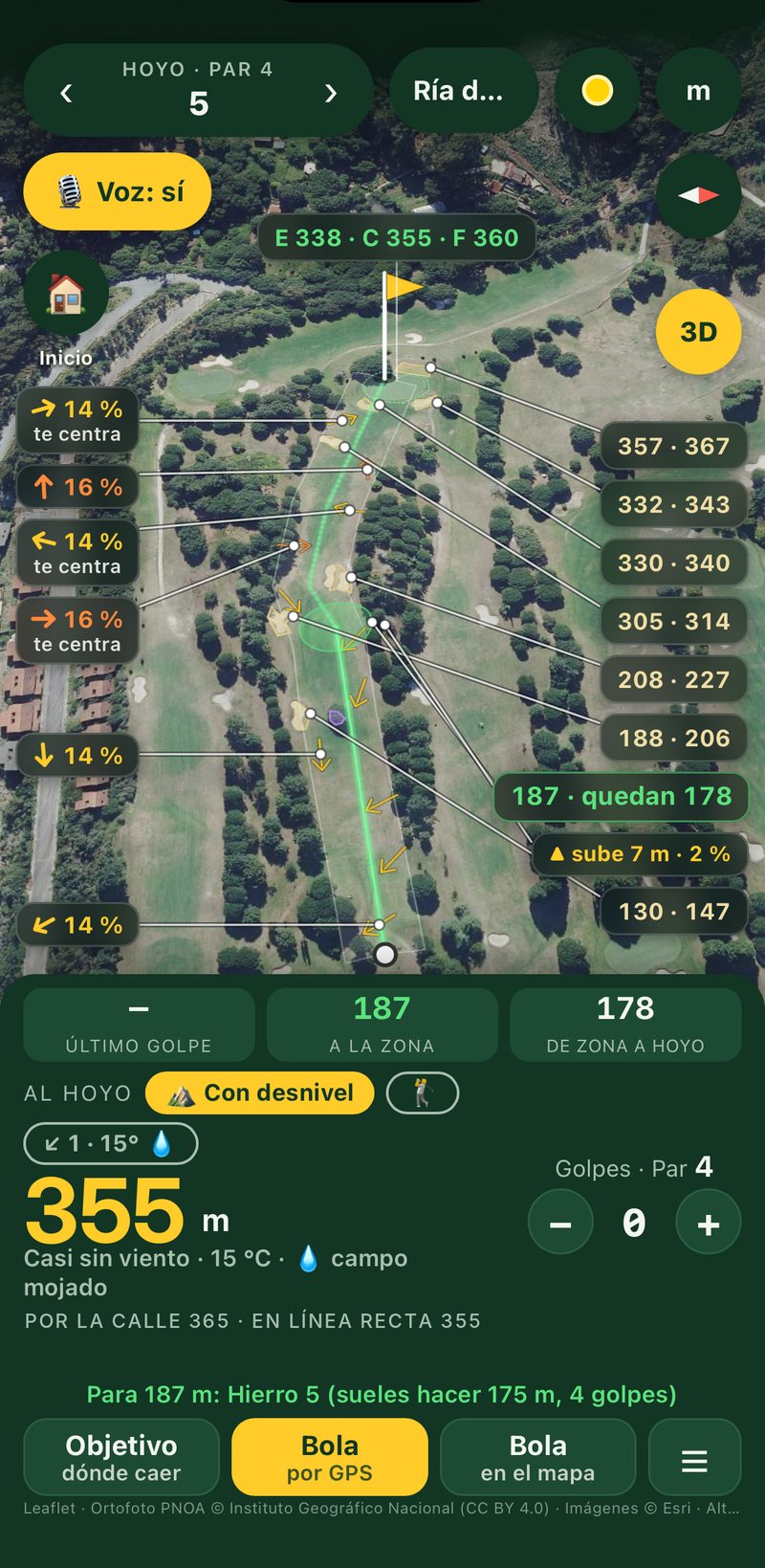
CaddieStroke works it out for you. As well as the GPS distance to the green, it tells you how far the shot really plays, adding slope, wind and temperature.
No more guessing whether the green is 4 or 12 yards up. And there's a competition mode to hide that data when you play a tournament.
Try CaddieStroke free
7-day free trial. iPhone only.
4. When the ball is on a slope
A sloping lie is a different matter. It changes less about distance and more about how you set up and where the ball goes. For a right-handed player:
| Situation | What happens | What to do |
|---|---|---|
| Uphill lie (left foot higher) | The ball flies higher and shorter | Shoulders parallel to the slope, ball slightly forward, one more club |
| Downhill lie (left foot lower) | The ball flies lower and runs more | Shoulders parallel to the slope, ball slightly back, one less club |
| Ball above your feet | Tends to go left | Grip down and aim a little right |
| Ball below your feet | Tends to go right | Bend your knees more, stay down and aim a little left |
In every case, make a slightly shorter swing and keep your balance. On a slope, a well-struck 80% shot beats a full swing that throws you off balance. If you're left-handed, swap left and right.
5. Can you use it in competition?
The Rules of Golf (Rule 4.3) let you measure distance with a device or an app, but don't allow elevation data in competition, unless a local rule says otherwise. In casual rounds and practice, you can use it.
That's why CaddieStroke has a competition mode: one tap hides slope and plays-like distance and leaves you just the real distance.
In short
Uphill, more club; downhill, less. When the ball is on a slope, set your shoulders parallel to it and make a shorter swing. And if you'd rather not guess the elevation, try CaddieStroke free for 7 days.
You might also like: golf club distances · how to film your swing with your phone · golf courses with GPS · golf handicap calculator.