Blog › On the course · 15 November 2026 · 5 min read
How wind affects your golf ball (and which club to take)
It's blowing in your face, you take one more club, hit it well… and still come up short. Wind is deceptive, and the higher you hit it, the more it matters.
Here is what wind does to the ball and how to play better on windy days.
1. What wind does to the ball
- Headwind: the ball gains backspin, climbs and drops almost dead. It comes up short: you need more club.
- Tailwind: the ball loses spin, flies flatter and goes further. You need less club, and it stops less on the green.
Wedges and high shots are affected more; low, running shots less.
2. How much more club?
It depends on the wind strength, its exact direction, the club and how high you hit it. By eye it's easy to get wrong, especially when the wind is gusting or you're sheltered by trees.
A useful tip: when in doubt into the wind, one club more and an easy swing beats the exact club and a forced shot. If there's elevation too, see our guide to uphill and downhill shots.
3. Crosswind
A crosswind changes direction more than distance. You have two options:
- Aim into the wind and let the ball drift back. It's the safest choice for most amateurs.
- Curve the ball against the wind so it flies straight. It looks great but takes a lot of practice.
Watch your natural shape: if your ball tends to go right and the wind blows right too, they add up and the ball will finish much further right than you expect.
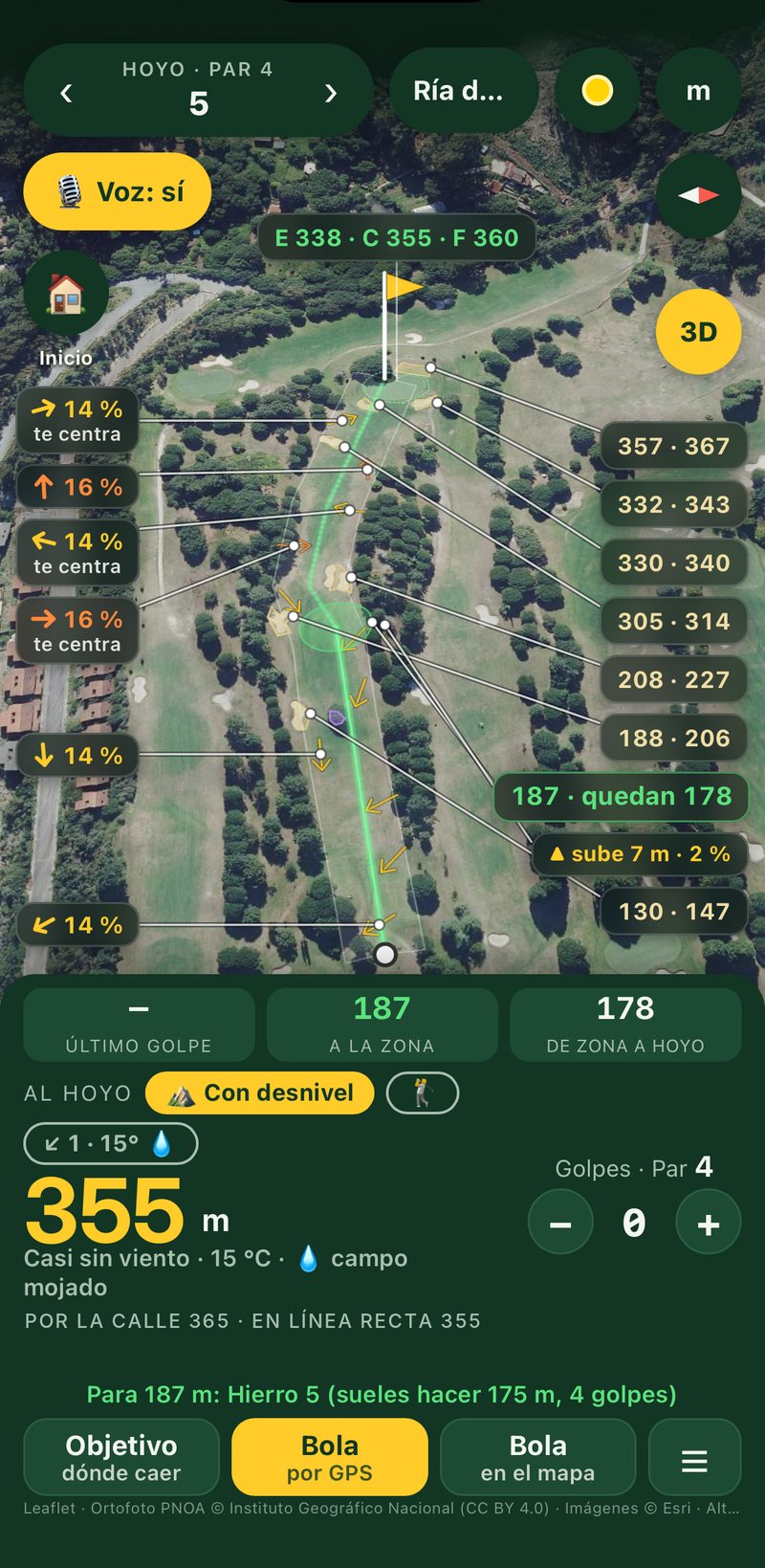
CaddieStroke works it out for you. The app checks the current wind and temperature and tells you how far the shot really plays, adding slope too. You can ask by voice: "golf, what's the wind?".
And in tournaments, competition mode hides what the rules don't allow.
Try CaddieStroke free
7-day free trial. iPhone only.
4. How to hit it low
On windy days a low ball is your best friend. As the saying goes: "when it's breezy, swing easy". Hitting harder adds spin and the ball climbs more, exactly what you don't want.
- Take one or two more clubs than usual.
- Grip down a little.
- Move the ball slightly back in your stance.
- Make a shorter, three-quarter swing and a shorter finish.
Practise it on the range before you need it on the course.
5. How to read the wind
- Look at the flag on the green, but also the treetops: it blows harder up high than at ground level.
- Toss some grass in the air and see where it goes.
- Watch the clouds and the water on lakes.
- Beware of trees: if you're sheltered, it may be blowing much harder above you than you feel.
Can you use it in competition?
Yes, with a catch. The rules let you check weather information, such as the wind forecast (Rule 4.3). What isn't allowed in competition is slope or plays-like distance. That's why CaddieStroke's competition mode hides the plays-like distance and leaves you the real one.
In short
Into the wind, more club; downwind, less. In a crosswind, aim into it. And when it blows hard, more club and an easy swing. If you'd like your iPhone to work it out, try CaddieStroke free for 7 days.
You might also like: uphill and downhill shots · golf club distances · golf courses with GPS · golf handicap calculator.